



Their relationships—and their nervous systems—are paying the price. This training teaches you exactly how to help.

Identify how attachment styles show up as posture, breath, and movement. Learn to read the body's relational story beyond what clients can articulate.
Work directly with the developmental movements (Yield, Push, Reach, Grasp, Pull, Take In) that form our relational blueprint. Heal interruptions at their source.
Guide clients through rupture and repair processes using somatic awareness. Build the capacity for secure connection even after profound relational wounds.
Hear what graduates are saying about their experience in the Attachment and Somatics training.

Move beyond talk therapy. Learn somatic methods to address attachment wounds that cognitive insight alone can't touch. Work with the body's procedural memory.
Add depth to your relational coaching. Understand how early attachment experiences create current patterns and learn to guide clients toward earned secure attachment..

Learn to recognize attachment dynamics in tissue holding patterns, breath, and nervous system activation. Work with relational imprints held in the soma.
Master the somatic dimensions of attachment dynamics in partnership. Learn to track co-regulation patterns and facilitate repair in relationships.

Understand how attachment patterns transmit across generations. Guide parents to break cycles and create secure bonds with their children.
Deepen your understanding of how attachment shapes the nervous system and developmental movement patterns. Refine your ability to track relational dynamics.
Insecure attachment affects over 60% of adults globally (Main & Solomon, 1990). That’s more than 4 billion people struggling with connection, trust, and intimacy. Insecure attachment isn’t just an emotional challenge—it’s a physiological reality embedded in nervous system patterns, postural organization, and somatic holding.
Left unaddressed, insecure attachment drives higher rates of anxiety and depression, chronic relationship instability, parenting struggles that perpetuate intergenerational patterns, and billions in healthcare costs from stress-related illness. The body remembers what the mind forgets. Without somatic intervention, insight alone rarely creates lasting change.
Have you watched clients understand their attachment patterns intellectually, yet remain unable to shift them relationally?
Explore the pioneering work of Bowlby and Ainsworth. Understand how attachment styles (Secure, Anxious, Avoidant, Disorganized) manifest somatically. Learn Polyvagal Theory and the Window of Tolerance as foundational frameworks for understanding nervous system states in relationships.
Experience the essential developmental movements of Yield, Push, Reach, Grasp, Pull, and Take In/Yield Completion. Discover how these patterns form our relational blueprint and learn to identify interruptions in this cycle that create lasting attachment wounds.
Develop sophisticated understanding of boundary styles (diffuse, rigid, flexible) and character strategies as intelligent adaptations. Master edge work techniques using gradual engagement and somatic oscillation to expand relational capacity safely.
Explore the somatic dynamics of closeness and distance in relationship. Learn to track fear's role in intimacy, cultivate attunement and resonance, and guide clients through vulnerability toward secure connection.
Master the art of rupture and repair across multiple contexts—interpersonal, practitioner-client, parent-child, and group systems. Learn somatic approaches to relational healing using Circle of Security, deep listening, Compassionate Inquiry, and restorative practices.
Synthesize all learnings into your embodied professional presence. Reflect on your journey through attachment and somatics, identify your learning edges, and develop sustainable practices for continued growth and ethical application.
I feel incredibly lucky to have found Kate! My expectations were greatly exceeded! Even though we met virtually, I felt supported emotionally through our weekly meetings as well as through email check ins. Engaging in this mentoring experience has greatly increased my confidence, has provided practical and relatable resources and ideas and has given my nervous system more capacity!
Before joining the Attachment and Somatics training, I noticed that when things became uncomfortable, I often shifted into a cognitive mode. I wanted to deepen my ability to stay present and embodied, even when anxiety or discomfort arises. The live sessions with Will and Kate were amazing — priceless. Beyond integrating somatic techniques, the course provided a deeply supportive environment to explore my own attachment styles. Even in an online setting, I felt deeply safe, seen, and supported. The way Will and Kate hold space creates a container that feels both grounded and transformative.
I knew I needed someone that had the depth of wisdom and experience to truly meet me where I was at and was so relieved to have found that in Kate. In such a short space of time I felt seen, heard and believed in a way that cannot be forced or faked. She is a gifted mentor with a holistic approach to supporting people as entire beings and she does this all with a breath of kind-hearted humour.
As I look back on my journey through the course, I feel immense gratitude for the depth of experience and shared humanity that unfolded in this space. My biggest takeaway was understanding that every human being has the same core needs: to connect, to be seen, heard, recognized, cared for, and loved. Connecting with such a diverse group of people and recognizing these shared commonalities deeply touched my heart and reaffirmed the power of connection as a healing force.
This course allowed me to explore more of myself and my attachment needs and difficulties than I had expected. It provided insight on how to repair after a rupture, and I am taking away new skills to incorporate into my practice, my relationships, and myself. I didn’t expect to re-experience my past as vividly as I did in relation to attachment, boundaries, and specific ruptures, but I find that it was necessary. This is just the beginning of my personal healing journey. Before beginning any process with a client, I need to ensure that I am in alignment with my own needs and fully present before helping a client move through reconciliation and repair.
Kate offered me a safe space in which to "rediscover all aspects of myself" and explore the various parts of my "inner family that were either too dominant and or not being acknowledged. She has been one of the most influential and authentic "guides" I have had the privilege of working with...and I have worked with many profound masters for more than 30 years.
I became aware that my attachment dynamics — personally and professionally — needed deeper embodiment. I was also seeing more clearly how early attachment development plays into chronic illness and neuroplastic symptoms later in life. The live group sessions were something I looked forward to every week, and I always felt more regulated afterward. There were several unexpected insights and transformations in my personal journey. This is a worthy investment for any practitioner wanting to deepen their understanding of early attachment cycles and somatic embodiment.

Answer a few simple questions to determine if this program is the right fit for you.

Once you have been accepted into the upcoming round of Trauma + Somatics, make your first payment.

Once you’ve made your payment, follow the instructions in your confirmation email to join the online learning portal.
Mondays via Zoom
8:00am – 11:00am PT / 10:00am – 1:00pm CT / 11:00am – 2:00pm ET
Click here to check your local Time Zone.
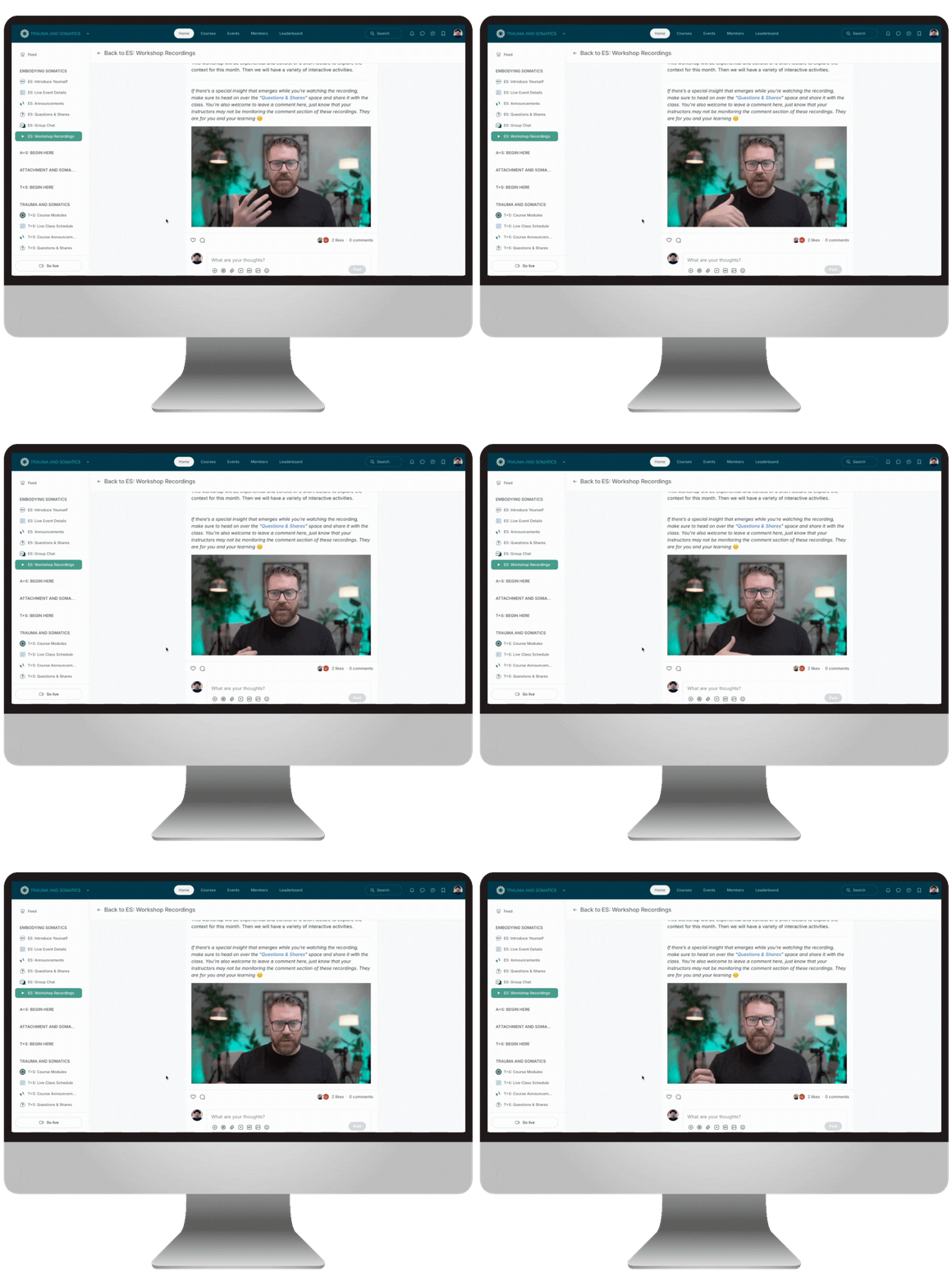
All live classes are recorded and students will retain lifetime access to all course materials.
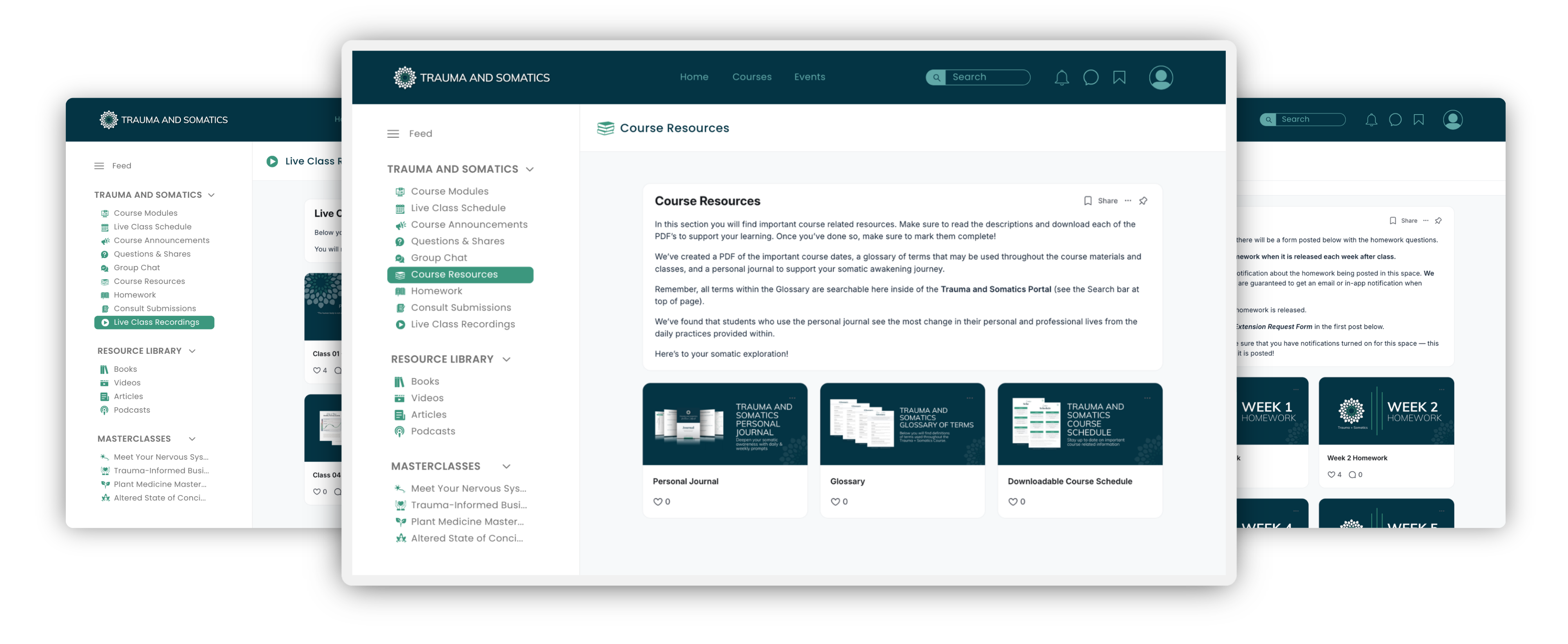
There are 6 self-study audio modules (9.5 hours total) released throughout the training. Each module contains audio lessons, guided practices, and workbook materials.
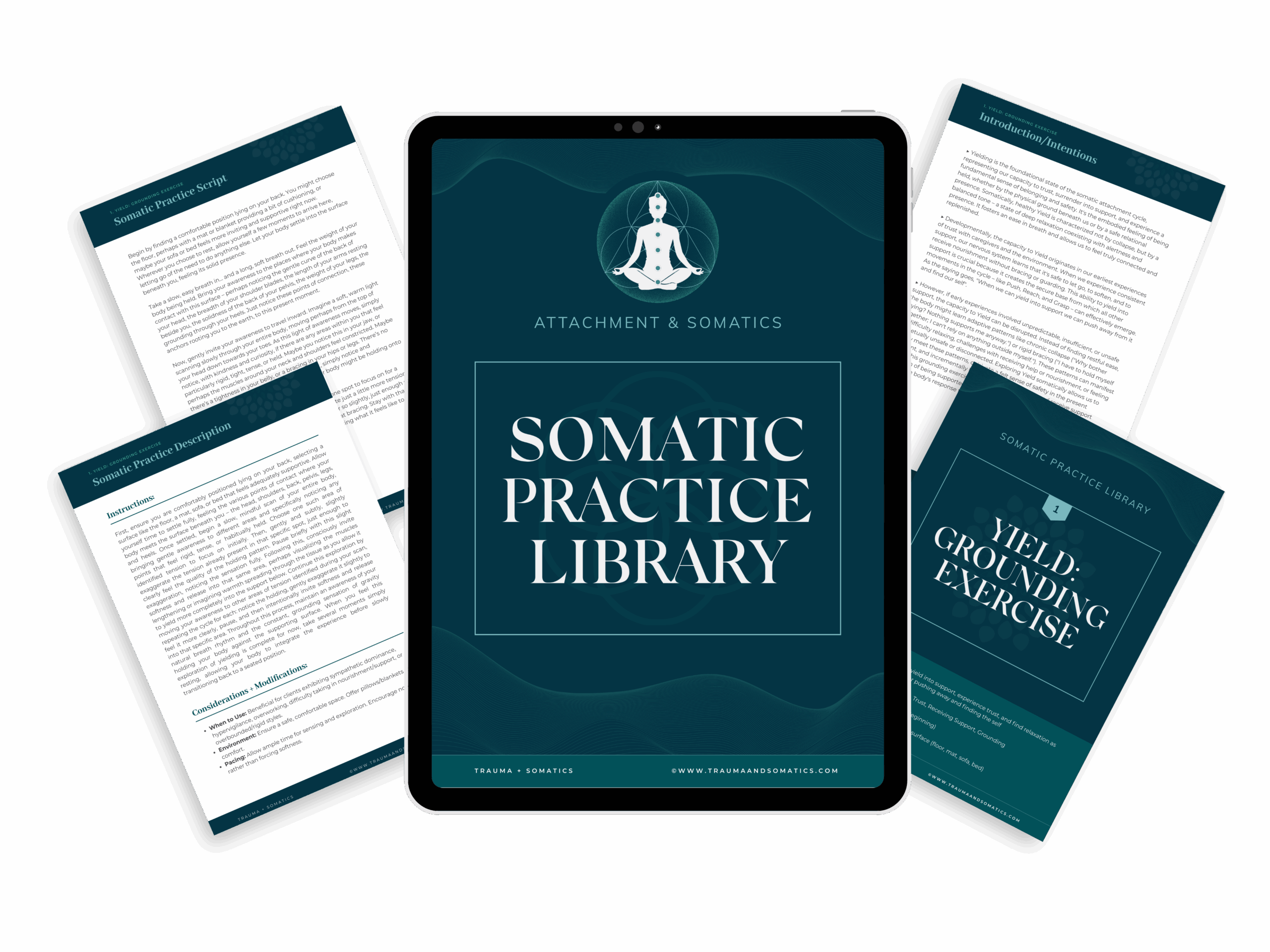
Access 16 guided somatic practices designed to deepen your embodied understanding of attachment dynamics and regulation.
To receive your certificate of completion, you must:
Kate Appleton brings a rich and diverse clinical background spanning five decades to this training. She masterfully integrates Somatic Experiencing®, Body-Mind Centering®, Internal Family Systems, Polyvagal Theory, and Dynamic Attachment Re-patterning (DARe) into a cohesive, relationally-focused practice.
Kate has worked as Special Education Teacher, Community Counselor, Somatic Coach, and Family Consultant. She is a contributing author to the manual combining Somatic Experiencing® and Safe Sound Protocol in clinical practice, and she has been deeply involved in Dr. Stephen Porges’ research on Polyvagal Theory.
Her work addresses the intersection of early developmental movement patterns, attachment, primitive reflexes, trauma, and archetypal exploration. Kate’s teaching style is warm, relational, and profoundly attuned, creating a learning environment that is both intellectually expansive and deeply supportive.
Will Rezin is an expert and educator specializing in applied somatics, trauma resolution, and developmental processes. As co-founder of Trauma and Somatics and founder of Formative Somatics, he brings over a decade of experience synthesizing contemporary neuroscience, psychological theory, and somatic methodologies.
Will’s work integrates Somatic Experiencing®, developmental attachment theory, sensorimotor approaches, and nervous system physiology with insights from esoteric traditions. His unique synthesis addresses the underlying psychophysiological organization shaping perception, behavior, and relational capacity.
He has worked with industry leaders from NASA, Google, Boeing, National Geographic, Fortune 500 companies, and Emmy award-winning producers. Will’s grounded, thoughtful approach builds trust and provides a calm, authoritative foundation for deep transformation.
Yes! We run two virtual trainings each year, beginning in February and August, If you would like to register early for an upcoming training, please send us an email here.
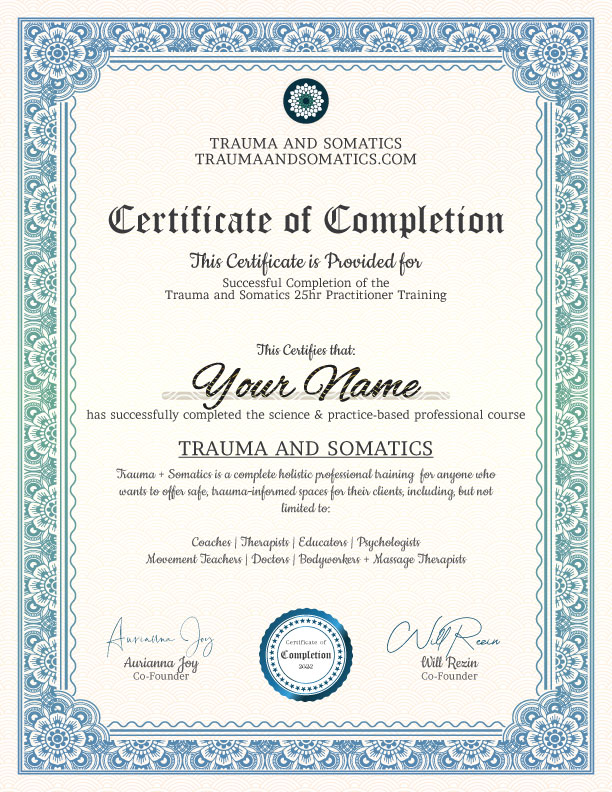
Receive your printable digital Trauma + Somatics Certificate of Completion simply by completing all of the lessons in the course within the program dates.
You will receive a printable personal journal to use both during the course and long after its completion to track your daily progress and deepen somatic awareness.
Join monthly workshops that blend movement, mindfulness, and community to reduce stress, deepen self-awareness, and foster transformation. This is your place to experience somatics.
To promote good professional practice, you are advised to use this training within the boundaries of your professional expertise and scope of practice. While Trauma and Somatics provides the knowledge of stress and trauma physiology, it is designed as a continuing education training and is therefore not a substitute for a professional training program, such as a coaching certification, massage therapy training program, psychology degree, doctoral program, etc. We recommend you receive foundational training in your chosen area of professional development before joining the program.
Trauma and Somatics is not a substitute for medical or psychological services of any kind. The information provided inside the course is meant for educational purposes only and is not intended to treat, diagnose, prevent, or cure disease. By joining the program, you are affirming that you are emotionally stable, in sound psychological health, and personally responsible for all of your own decisions and commitments. The founders of Trauma and Somatics are not responsible for any decisions made as a result of the training program.