The Practitioner's Guide to Somatic Language
Words That Shape Safety.
A practical toolkit for invitational language. Learn to communicate in a way that honors the nervous system and invites organic formation.


We know that language is powerful. We intend to create safety, yet standard clinical or coaching language often inadvertently triggers defense. We ask questions to get answers, but we miss how the quality of the question shapes the individual’s physiological response.
It happens in a moment:
- You ask an individual to "calm down" or "take a breath," and you witness their system tighten in resistance.
- You offer an interpretation of their experience, and they withdraw, feeling unseen.
- You try to guide a practice, but your directive tone activates a subtle fight-or-flight response.
You feel the disconnect. The gap between your compassionate intention and the actual impact of your words leaves you feeling ineffective and the individual feeling unsafe.
Language is a somatic intervention.
Your words speak directly to neuroception, the body’s unconscious surveillance system. A directive command can register as a threat to autonomy; a judgment registers as danger. To support true reorganization, we must shift our language from directing the experience to inviting the formation.
When we move from command to invitation, and from interpretation to reflection, we create a container where the individual’s system can differentiate and organize itself without defense.
A Toolkit for Invitational Dialogue
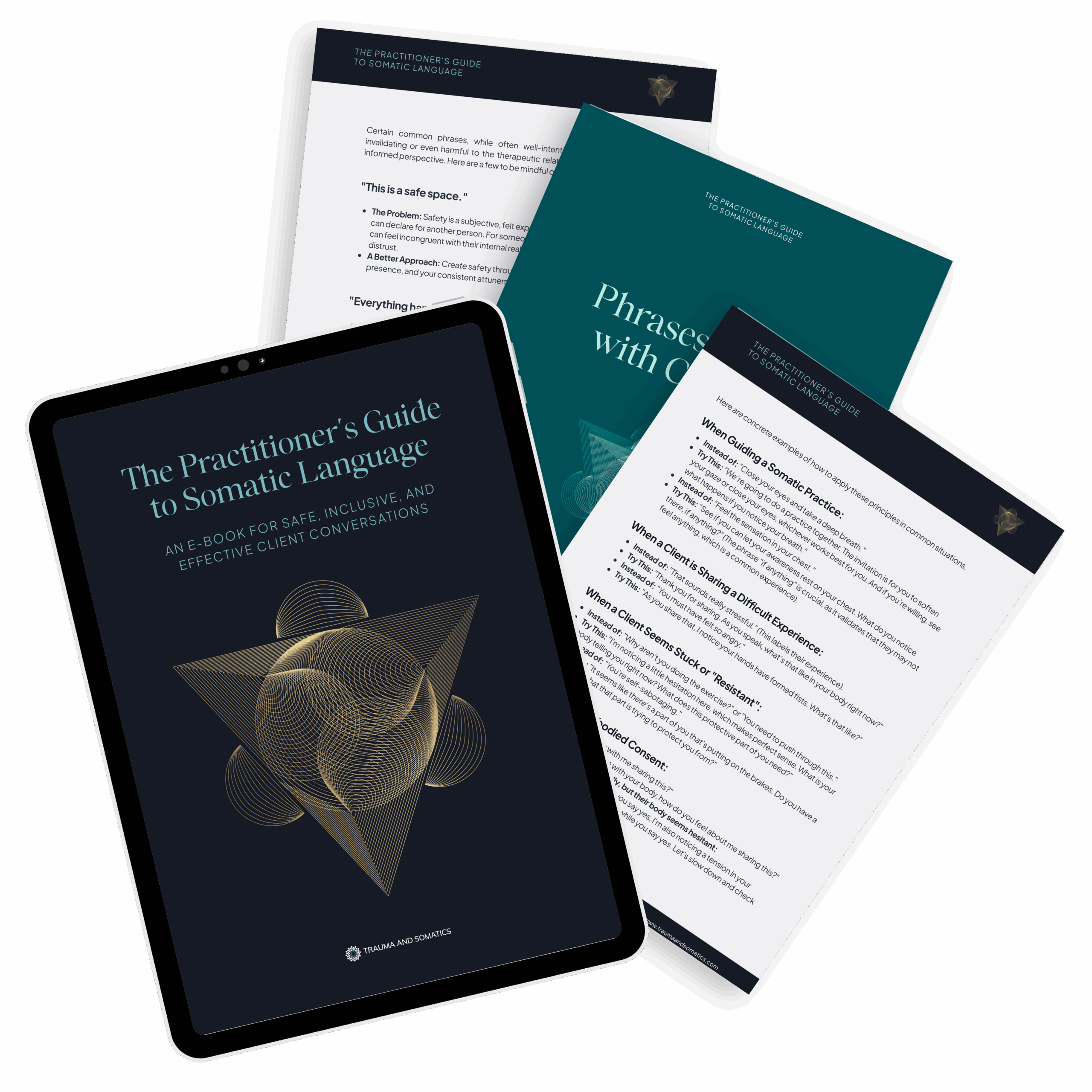
The Practitioner’s Guide to Somatic Language is a 5-page reference guide for refining your verbal artistry.
This is about learning the principles of acoustic safety. It provides the concrete linguistic tools to communicate in a way that honors autonomy and reduces defensive reactions.

What’s Inside This Guide:
- The 3 Core Principles: Invitation over Direction; Reflection over Interpretation; Curiosity over Certainty.
- Somatic Scripts: Precise phrasing for guiding practices and exploring difficult sensations (e.g., swapping "Close your eyes" for "I invite you to soften your gaze").
- State-Specific Language: How to adapt your prosody and pacing when accompanying a mobilized (Sympathetic) vs. a shutdown (Dorsal) system.
- Phrases to Use with Caution: A list of common, well-intentioned phrases that can disrupt safety, and what to say instead.
- Quick-Reference Chart: A side-by-side comparison of Directive vs. Invitational language for your desk.
What Practitioners Are Saying
“I never realized how much my ‘helpful’ instructions were actually creating resistance until I read this. Changing my language to be more invitational has completely shifted the depth of my sessions.”
— Somatic Therapist
“Simple, profound, and immediately applicable. Will’s approach to language honors the dignity of the client’s process in a way I haven’t seen elsewhere.”
— Trauma-Informed Coach
Access Your Guide
Refine your most constant intervention: your voice. For the introductory price of
$19
(Regular Price: $39)
learn to speak the language of the nervous system.
Frequently Asked Questions
- Is this just for talk therapists?
No. This is for any practitioner who uses words to guide an individual. This includes bodyworkers, yoga teachers, and coaches. If you speak to the people you work with, this guide is relevant.
- How is this delivered?
This is a digital PDF download, sent immediately to your inbox.